Nonprofits
The Night $4.6 Million Moved Over Wi-Fi
Event network infrastructure for the charity:water Gala at the Metropolitan Museum of Art
At a Glance
- Client
- charity:water — a nonprofit bringing clean water to communities in developing countries
- Venue
- The Metropolitan Museum of Art, Temple of Dendur in the Sackler Wing, New York City
- Problem
- Support hundreds of simultaneous high-stakes devices — guest iPads used for donations and real-time projection systems — through a dense urban RF environment, during a single high-pressure evening where wireless failure meant fundraising failure.
- Services
- RF environment assessment · equipment specification and procurement · on-premises wireless controller deployment · firewall and traffic management · event production coordination · on-site network operations
- Platforms
- Ruckus wireless APs and ZoneDirector controller · FortiGate firewall · Metropolitan Museum fiber WAN uplink
- Outcome
- 500-device-capacity network, zero issues on the night. 400 guests raised $4.59 million for clean water in Cambodia and Ethiopia — the network was invisible, as intended.
The Event
A fundraising gala where the network was the mechanism
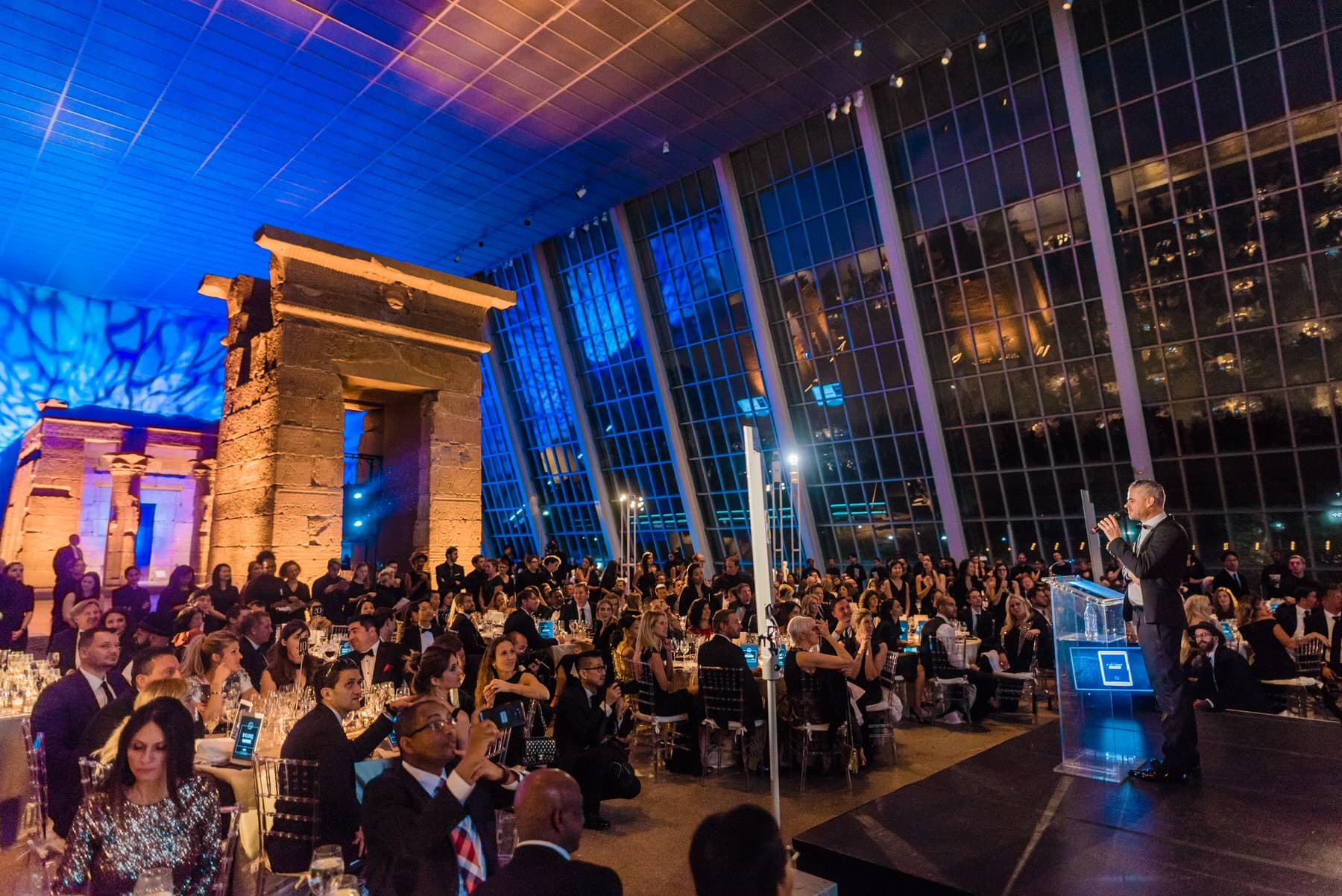
Inside the Metropolitan Museum of Art, in the glass-ceilinged Sackler Wing, sits the Temple of Dendur — a 2,000-year-old Egyptian temple surrounded by a reflecting pool, framing the New York night sky above. It is one of the most extraordinary rooms available for an event in the world.
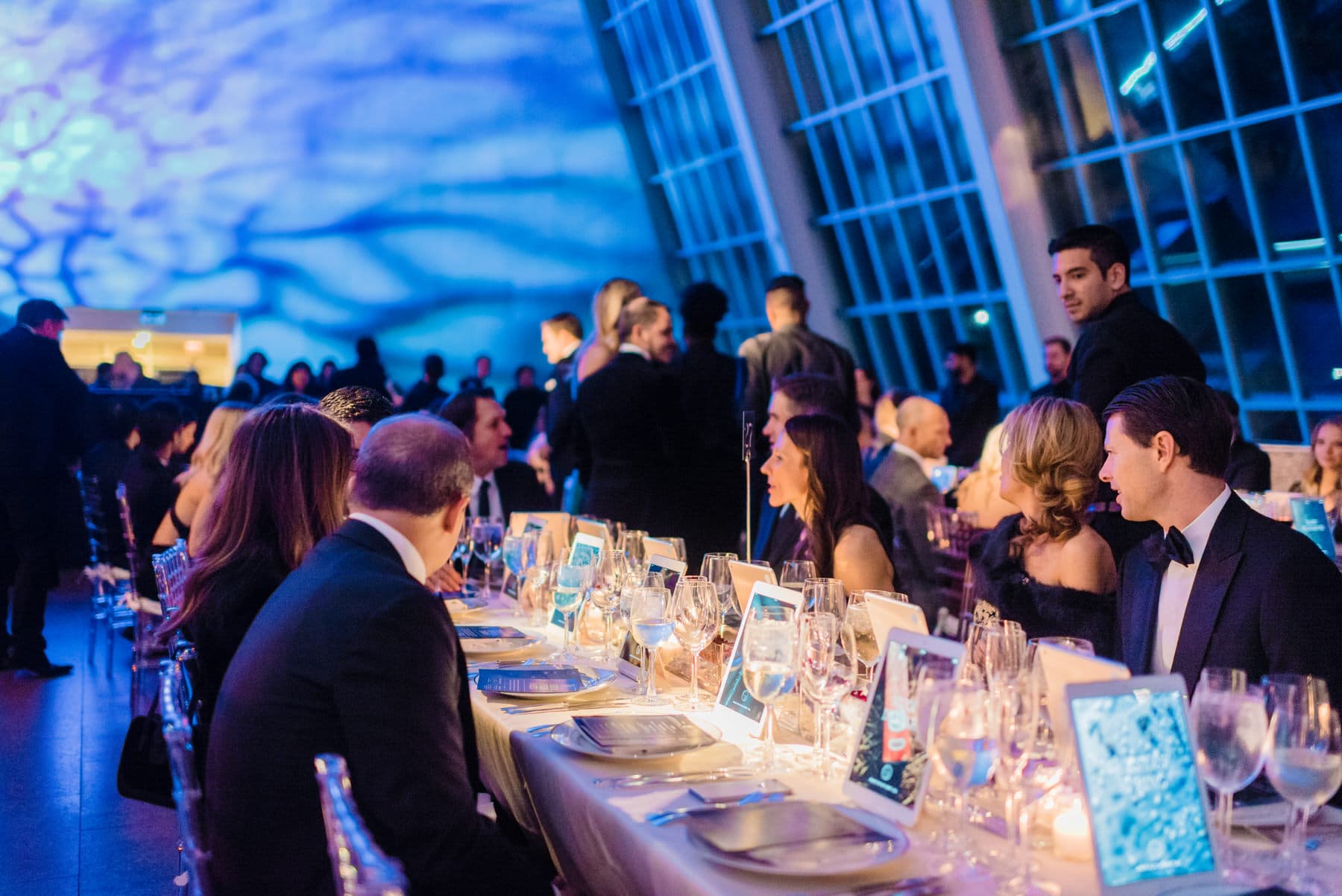
charity:water chose it as the backdrop for their annual black-tie gala: 400 guests, Christie's auctioneers on stage, real-time donation totals projected onto the museum walls, the room ringed with neon-yellow jerry cans — charity:water's signature symbol of the water crisis. An iPad sat at every table, loaded with a personal story about a specific family in Ethiopia, waiting to unlock at the right moment in the program.
At the center of all of it was a wireless network. The iPads guests used to make donations. The live-projection system tracking cumulative giving in real time. The simultaneous unlock that asked every table to give at once. Every one of those systems needed reliable, high-capacity wireless to function — and in a room where an iPad freezing mid-program would have interrupted a fundraising mechanism raising millions in minutes, "probably fine" was not an acceptable standard.
The evening raised $4.59 million — enough to bring clean water to 153,000 people.
The Challenge
Dense city, dense room, no margin for error
Event wireless in New York City is harder than event wireless almost anywhere else. The RF environment is saturated — neighboring networks, adjacent events, and the interference profile of a dense urban building all compete for the same spectrum. Add several hundred devices associating simultaneously in a single space, with traffic that spikes sharply at specific program moments, and the failure modes become very specific and very predictable. A network sized for average load falls over at peak. Access points that work during setup behave differently when the room fills. Traffic that looks fine during testing looks completely different when five hundred devices are contending at once.
Planning for those moments — not average conditions — was the whole exercise.
The Approach
Spec for the spike, test before the night
The first step was traffic modeling: estimating the number of concurrent devices, the traffic profile at peak moments in the program, and the density requirements for the two primary spaces — the Temple of Dendur and the Great Hall. With that baseline, we specified equipment sized for the peak, not the average, with a spare access point on standby.
The wireless layer was built on top-of-the-line Ruckus access points, chosen specifically for their performance in high-density environments, managed by an on-premises Ruckus controller. Running a local controller rather than relying on cloud management meant the network had no external dependencies during the event — no cloud path, no external service that could go wrong at the wrong moment. A FortiGate firewall sat at the perimeter, handling traffic shaping and security. The WAN uplink ran over fiber from the Metropolitan Museum's own network infrastructure — a clean, high-capacity connection already in place at the venue.
Two access points covered the Temple of Dendur. Two covered the Great Hall. The fifth was on the shelf, ready to swap in if anything failed. Everything was tested before the guests arrived. By the time doors opened, every failure mode we could anticipate had already been found and resolved.
On the Night
Radios on, ready for anything
For the duration of the event, one team member was on-site and on radio with the event production team — aware of every moment in the schedule that would drive a traffic spike, coordinating in real time with the people running the program. A second team member was standing by off-site in case of emergency.
Nothing required them. The issues had been found during testing, not during the gala. The network ran the evening without intervention, absorbed the spikes, and stayed invisible — which is exactly what a good event network is supposed to do.
The Partnership
Equipment donated as an in-kind contribution
RSystems loaned the full equipment stack — FortiGate firewall, Ruckus wireless controller, access points, and switching — to charity:water at no cost, as an in-kind donation valued at over $11,000. The professional fees covered the design, coordination, installation, and on-site operations. The hardware was our contribution to the mission.
The work we do at events like this — making sure a wireless network behaves for a few hours inside a museum — is in direct service of something much larger. The funds raised that evening will bring clean water to communities in Cambodia and Ethiopia for generations. We were glad to play a small part in making that night work.
Outcomes
What we delivered.
- 500-device-capacity wireless network across two spaces in one of the most RF-dense cities in the world
- Enterprise-grade Ruckus access points and on-premises controller — no cloud dependencies during the event
- FortiGate firewall with traffic shaping at the perimeter
- Fiber WAN uplink via the Metropolitan Museum's own infrastructure
- Full traffic modeling and peak-load planning before equipment was specified
- On-site network operations and radio coordination with event production throughout the evening
- Zero issues on the night — all failure modes resolved during pre-event testing
- Full equipment stack donated as an in-kind contribution at no cost to charity:water
Bulletproof the Wi-Fi
Hosting an event where the Wi-Fi simply cannot fail?
We plan and deploy high-density, temporary networks built for crowds, payments, and live operations. Let's scope the network for your next event.
Let's TalkRelated
To stand up reliable network and Wi-Fi for a high-stakes event, start with these services:
For the technology behind high-density event Wi-Fi, see our University guides on WiFi and its vendors:
Another high-stakes event we kept online: