Our Origins: How Precision Became Our Philosophy
A story about precision, verification, and the cosmic perspective that informs everything we build.
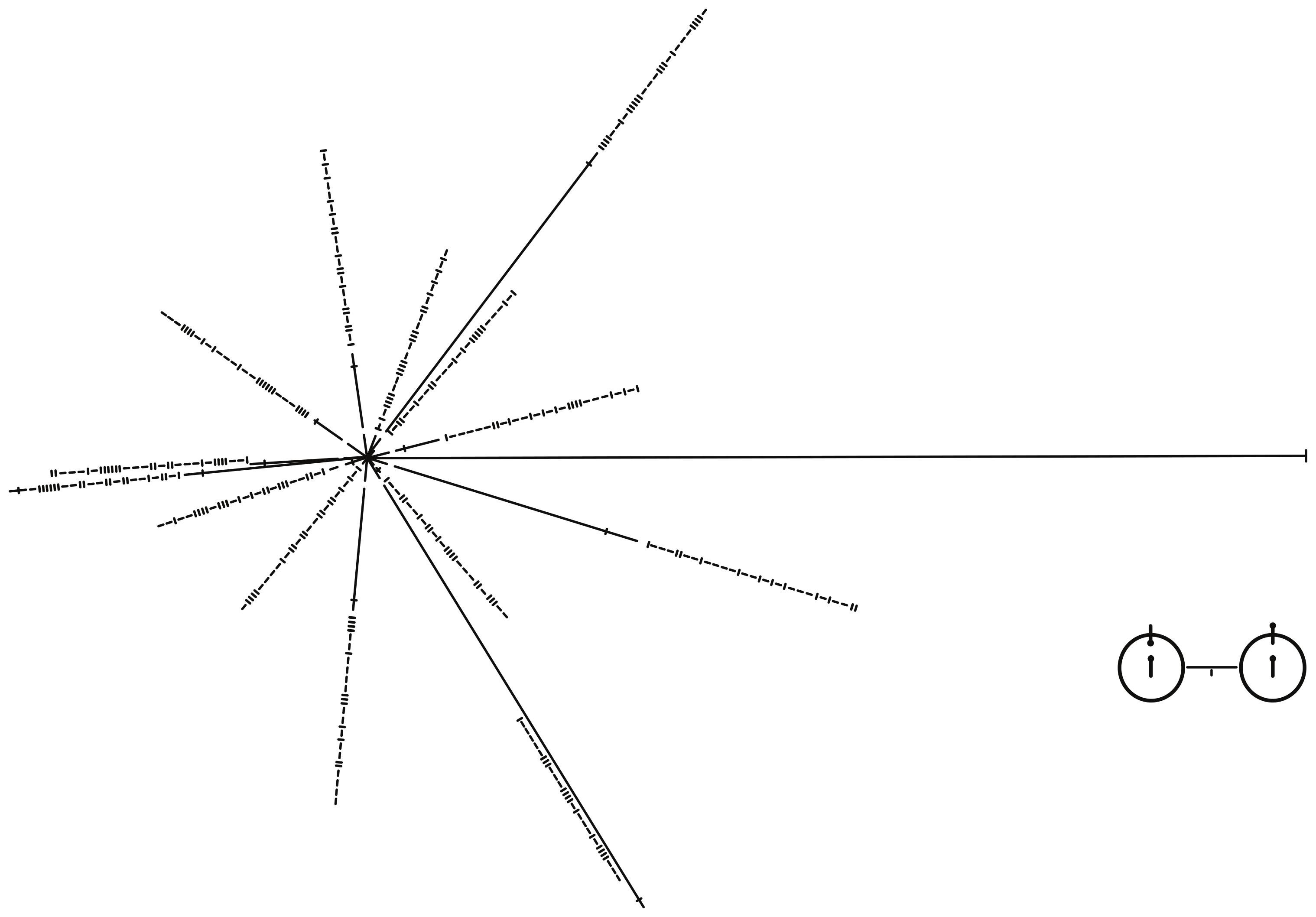
In 2014, I was at a hockey game with a friend Devin, talking about the Voyager spacecraft and Carl Sagan — someone I've admired my entire life. He casually mentioned: “I always thought it'd be cool to get a tattoo of the pulsar map.”
I'd never considered it before. But the idea took off.
Weeks later, I asked if I could steal the idea. But I didn't want to just get the same pulsar map that Sagan and NASA had sent into the cosmos in 1977. I wanted to make it mine. More unique. More ambitious. A real challenge that would force me to learn new mathematics, do actual science, and push myself further than I'd ever pushed before.
So I set out to calculate my own pulsar map — one that would pinpoint exactly where I was born, down to within hours or days, using the same principles that made the Voyager map a cosmic message for the future. A map that would remind me, every single day, of my exact place in space and time. A coordinate in the universe.
The Math
The foundation is the pulsar timing equation — a differential equation that describes how a pulsar's frequency changes over time:
f(t) = f₀ + ḟ·t + (1/2)f̈·t² + ...
Where f₀ is the baseline frequency, ḟ is the spin-down rate (how fast the pulsar is slowing), and t is time. Each pulsar decays at its own rate. That decay rate is constant — which means a given combination of pulsar frequencies can only occur at one moment in time. It's a cosmic timestamp.
The inverse problem is elegant: if I knew the exact frequencies of 14 pulsars at my birth moment, I could encode them into a map. That map would be unique to that moment. No other time in the universe would produce that exact combination of frequencies.
The challenge: I needed precision. Lots of it.
The Data Problem
The original Drake/Voyager pulsar map used observational data from the 1970s. That data had limited significant figures — enough to pinpoint the launch within months, but not days. For my map, I wanted to do better, a lot better.
More significant figures in the pulsar data meant tighter constraints in my calculations. So I needed contemporary observational data, not 40-year-old archives.
I started with the 1990 Astronomical Almanac, which the US Navy published for celestial navigation. Better precision than the 70s, but when I ran the numbers, it still wasn't enough. The significant figures were insufficient. I was back to square one.
Then I found the Parkes Observatory in Australia — one of the world's leading pulsar research facilities. They maintain a publicly accessible database with high-precision timing data from active radio telescope observations. Real contemporary measurements with the decimal-place accuracy I needed.
I pulled data for the 14 pulsars from the Drake map, measurements taken on dates near my birth in 1990. Parkes didn't have a data point exactly on my birthday, but they had many nearby dates. I used statistical analysis across multiple observation dates to extrapolate backwards and forwards, quantifying the error bounds in each calculation. The result: a pulsar frequency fingerprint for my birth moment, accurate to within ±2 days.
But I still needed verification.
The Verification
I wrote to every member of Columbia University's Astrophysics Department. I also reached out to scientists at the American Museum of Natural History and the Hayden Planetarium. Radio silence across the board. Six weeks of repeatedly unanswered emails. Then finally, the Columbia department chair responded: “Office hours Tuesday 4–5. Come over and we'll do the math.”
I brought him a bottle of bourbon and asked him to check my work. He refused — but offered something better. He said he'd rederive the problem from scratch on the chalkboard, independently solving it to see if he arrived at the same answer.
We put up the differential equations. Started working through each term. Then I caught something: “Shouldn't there be an f₀ term here?”
He paused. “No, that's accounted for —” Then he stopped. “Wait. Actually, you're right. There should be. Yes. There's the f₀ term.”
That moment was everything. I wasn't just following along. I was contributing. I'd mastered this enough to catch an astrophysicist's mistake. I understood the physics.
As we finished, his colleague walked by, poked his head in, and asked what we were working on. The chair explained. The colleague said, “Oh, I actually have a program on my computer that calculates what those pulsars were flashing at any given time.”
He ran the calculation, and sent me back the frequencies. They aligned perfectly with my results. Independent verification: my math was correct.
The Art
Now I had numbers. But I needed to visualize them.
I found a programmer in Florida who'd built a tool that takes pulsar data, plots it as a map, and converts the frequencies to binary — using the hydrogen line frequency (~1420 MHz) as the scale reference. The hydrogen frequency is a universal constant, something any advanced civilization anywhere in the universe would recognize. It's the Rosetta Stone of cosmic messaging.
My friend Eri — an amazing artist — took the PNG output and recreated it in Illustrator as a vector image. Precise, scalable lines that could survive the translation to skin.
Then I started searching for a tattoo artist who specialized in fine linework. The first one I found turned me down flat. “We know all about pulsar maps,” they said. “We do art, not science. And this is too small. It needs to be bigger.”
They were right. I found a second artist who agreed to take it on, and we moved the placement from my bicep to my thigh — a bigger canvas, enough space to render the fine detail work properly.
After months of calculation, validation, art direction, and refinement — three hours of needle work — it was made permanent.
Why It Matters
Every day I look at this tattoo running down my leg, I'm reminded of something Carl Sagan understood better than almost anyone: we are made of star stuff, orbiting an unremarkable star in an unremarkable galaxy in an incomprehensibly vast universe. We are brief. We are small. And that brevity — that scarcity of time — makes every moment matter.
This is how I approach my work at RSystems. Not just the technical details, but the entire practice of engineering with intention. Rigor. Ownership. Getting it right.
I don't cut corners. I verify my work. I ask hard questions upfront. I push past the obvious solution to find the right one. I care about precision not as an aesthetic, but as a moral commitment — to the work, to the client, to doing something the way it deserves to be done.
Every project gets this same attention. Every decision is deliberate. Every system is built with the understanding that precision reflects character. That attention to detail is not a luxury — it's foundational.
Because time is finite. Our window to do meaningful work is small. We don't get to squander it on half-measures or compromises. We get to build things that matter, with the same rigor and intention that goes into mapping your place in the cosmos.
Your infrastructure should be as precisely engineered as a pulsar map. It should be designed with intention. It should reflect the care and discipline of the people building it.
That's RSystems.