
Virtualization · Networking · Hardware
iSCSI
Also known as: Internet Small Computer System Interface
iSCSI is a storage networking protocol that carries SCSI storage commands over standard TCP/IP Ethernet, allowing servers to access block-level storage on a NAS or SAN as if it were a locally attached disk.
iSCSI makes networked storage look and behave like a locally connected drive to the operating system. A server running an iSCSI initiator (software built into Windows, Linux, and VMware ESXi) sends SCSI commands over Ethernet to an iSCSI target on a storage device (a Synology NAS, a dedicated SAN, or any iSCSI-capable storage array). The storage array presents a LUN (logical unit number) — effectively a virtual disk — that the server formats and uses like any other volume.
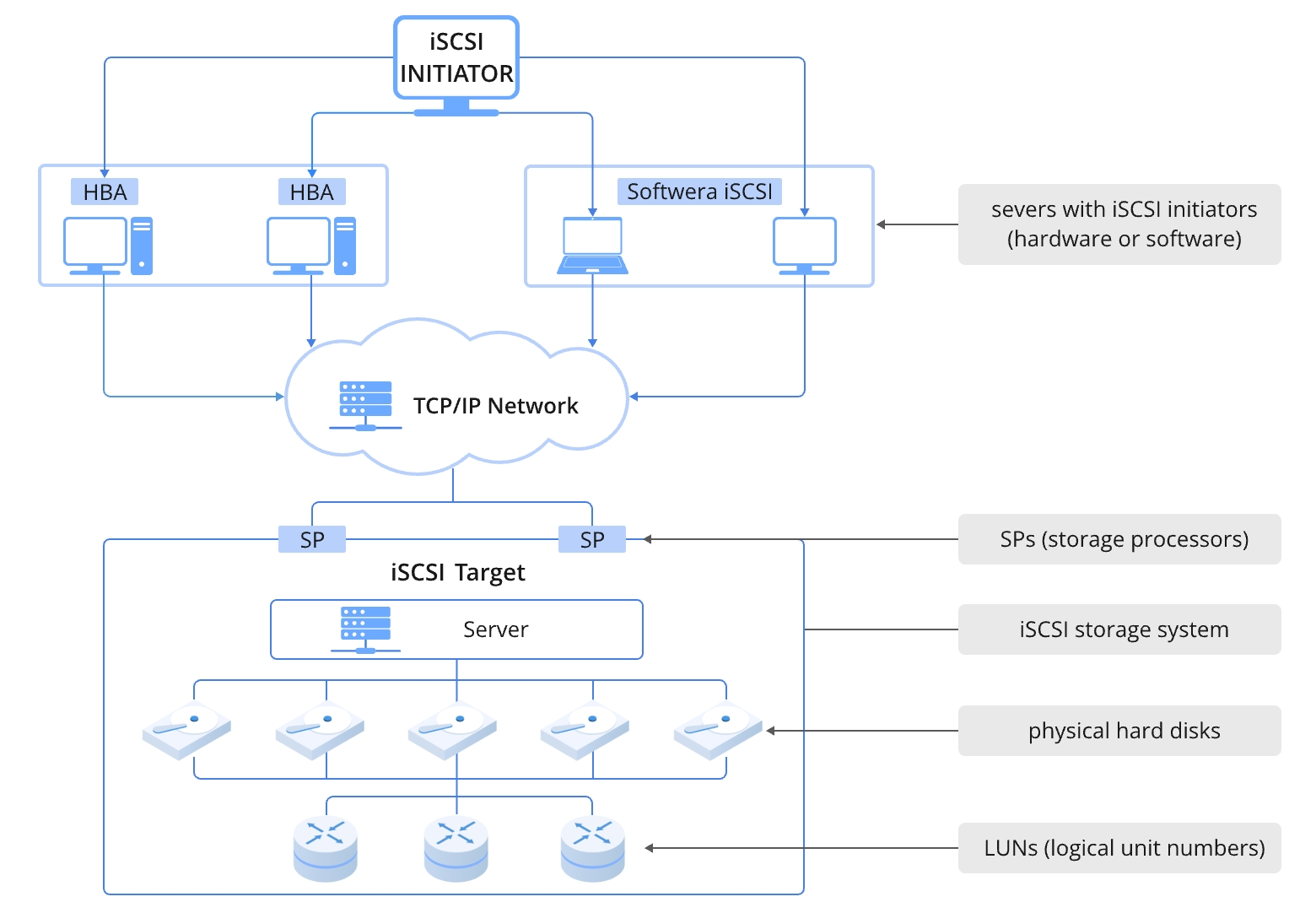
Why iSCSI matters for virtualization
iSCSI is the most common protocol for shared storage in SMB and mid-market VMware and Hyper-V environments. Shared storage is what makes live migration and VM clustering possible — multiple hypervisor hosts access the same datastore, so a VM can move between hosts without copying its disk files.
Performance requirements
For reliable iSCSI performance, especially in production environments:
Dedicated VLAN — iSCSI traffic should be isolated from general data traffic on its own VLAN (typically unrouted, L2-only).
Jumbo frames — enable 9000-byte MTU end-to-end (every switch port, every NIC in the path). Reduces CPU overhead for large block transfers.
LACP / multipathing — iSCSI multipathing (MPIO on Windows, native multipathing in ESXi) uses multiple network paths for both redundancy and throughput.
10G minimum — 1Gbps iSCSI is workable for light loads but shows strain under heavy VM I/O. 10G is the practical baseline for production use.